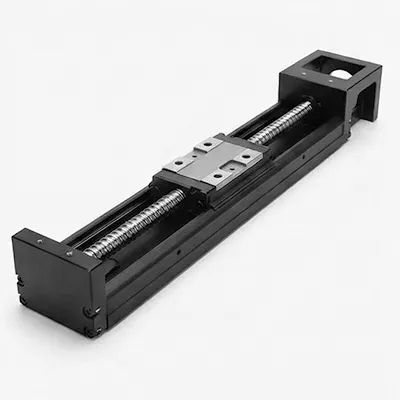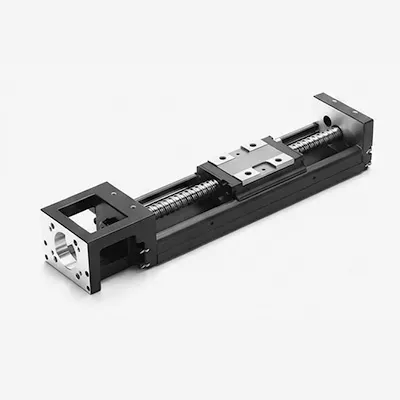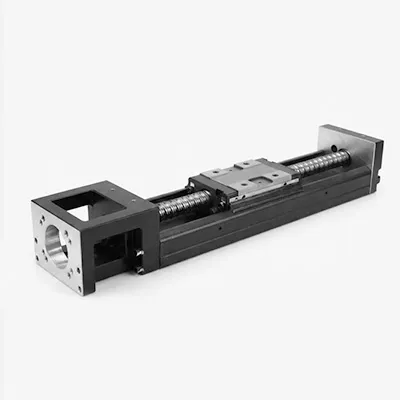
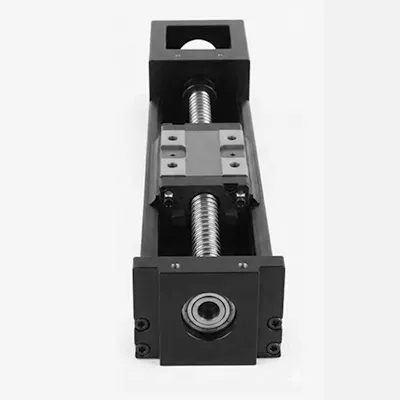
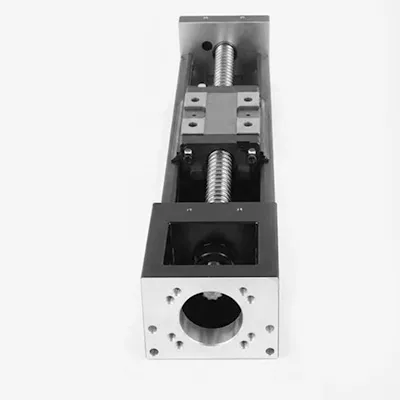
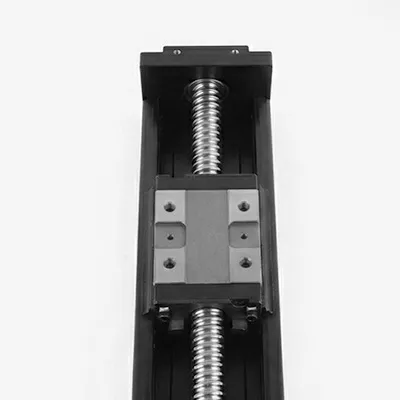
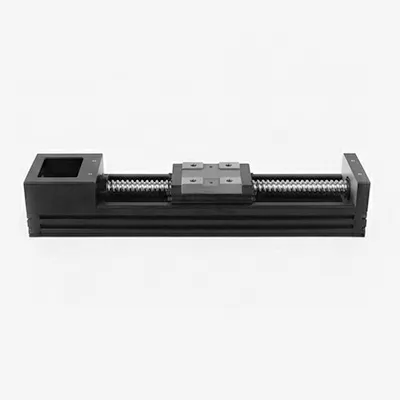
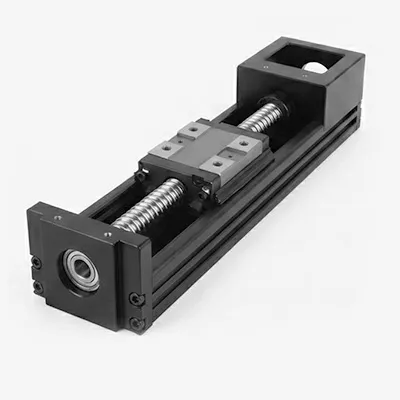
When your application demands uncompromising load capacity and rigidity, the KK60 is your go-to choice. As one of the larger modules in the KK series, it features a 60mm wide body and a more robust ball screw. The KK60 not only handles heavy loads exceeding 30kg with ease but is also frequently used as the X-axis base for multi-axis robotic arms.
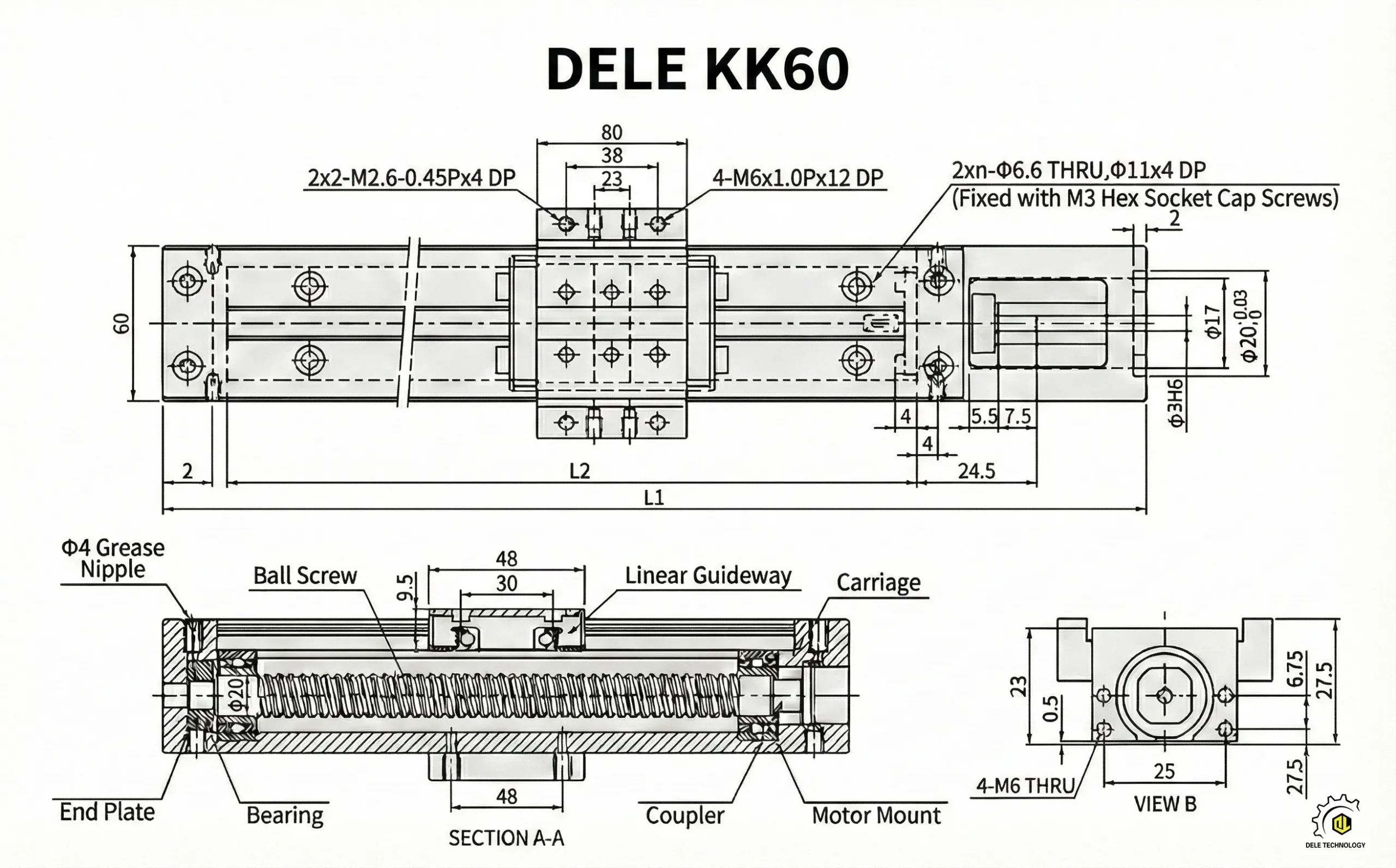
| Category | Parameter | Specification / Value |
| Basic Dimensions | Module Width | 60 mm |
| Module Height | 33 mm (Rail Base) / 42 mm (With Block) | |
| Rail Type | High-Rigidity U-shaped Steel Rail | |
| Block Type | Standard / Long (High Load) | |
| Drive System | Drive Mechanism | Precision Ground Ball Screw |
| Screw Diameter | Ø 12 mm / Ø 16 mm (Depends on spec) | |
| Screw Lead Options | 5 mm / 10 mm / 20 mm | |
| Max. Stroke Range | 150 mm ~ 1200 mm (Customizable) | |
| Performance | Accuracy Grade | Precision (P) / Normal (C) |
| Repeatability | P: ±0.003 mm C: ±0.010 mm |
|
| Max. Speed | Up to 1,300 mm/s (Depends on lead & stroke) | |
| Max. Acceleration | 1.0 G (Standard) | |
| Load Capacity | Basic Dynamic Load (Ca) | 8,500 N ~ 13,200 N |
| Basic Static Load (C0a) | 14,000 N ~ 22,500 N | |
| Allowable Static Moment (Mr) | Rolling: 250 N•m ~ 450 N•m | |
| Allowable Static Moment (Mp) | Pitching: 120 N•m ~ 220 N•m | |
| Allowable Static Moment (My) | Yawing: 120 N•m ~ 220 N•m | |
| Material & Environment | Main Body Material | High Carbon Steel |
| Surface Treatment | Anti-rust Oil / Electroless Nickel Plating | |
| Motor Compatibility | NEMA 23 / NEMA 34 / 200W-400W Servo |
In automated equipment selection, engineers often share a consensus: “For heavy loads and long cantilevers, go with the KK60.”
But have you ever wondered why, despite being only 10mm wider than the KK50, the KK60 achieves an exponential increase in bending and torsional resistance? This isn’t simply a matter of piling on more material—it stems from structural mechanics and geometric design.
Today, we’ll skip the dry spec sheets and instead take you on a microscopic journey to dissect the technical logic behind the KK60’s formidable performance.
The defining feature of the KK60 lies in its monolithic U-shaped steel base. Mechanically, this design maximizes the section’s second moment of inertia.
Simply put, the farther a material is from the “neutral axis,” the greater its bending resistance.
This structure enables the KK60 to exhibit deformation resistance approaching that of solid steel when subjected to lateral and pitching forces. For X-axis applications requiring high dynamic response, this translates to shorter settling times and reduced end-stick.
Rigidity stems not only from the base but also from the contact surfaces. The KK60 employs a high-precision Gothic groove design.
This is why the KK60 is termed an omnidirectional load-bearing module. During complex spatial trajectory movements, it ensures constant frictional resistance, preventing “stuttering” or sudden precision fluctuations caused by changes in force direction.
The KK60 is frequently used for long-stroke transmission, introducing another core concept: slenderness ratio.
As stroke length increases, the lead screw becomes slender and prone to bending vibration at high rotational speeds, reaching its critical speed.
Consequently, for an identical 1000mm stroke, the KK60 can operate at higher rotational speeds than thinner screw modules without generating resonance noise. This isn’t merely about thickness; it represents finding the optimal physical balance between speed and stability.
Whether handling heavy loads on a single axis or building complex robotic arms, the KK60 is the reliable choice you can count on. If you’re unsure whether your load requires the KK60, feel free to reach out to our technical support team anytime!
Our engineers are ready to provide you with consulting services.
We promise to keep your information strictly confidential
Upload drawings or send inquiry plans, our engineers will provide you with a manufacturability analysis (DFM) and quotation within 24 hours.