
In the realm of precision automation, the “KK Module”—originally popularized by HIWIN but now a standardized form factor across the industry—occupies a unique niche. It is the workhorse of the semiconductor, medical, and optical inspection industries. However, after years of integrating these modules into complex gantries and inspection stages, I have observed a recurring pattern: engineers often select these modules based on basic stroke and load ratings, overlooking the subtle dynamic behaviors that dictate true system performance.
The Structural Philosophy: The U-Shaped Steel Rail
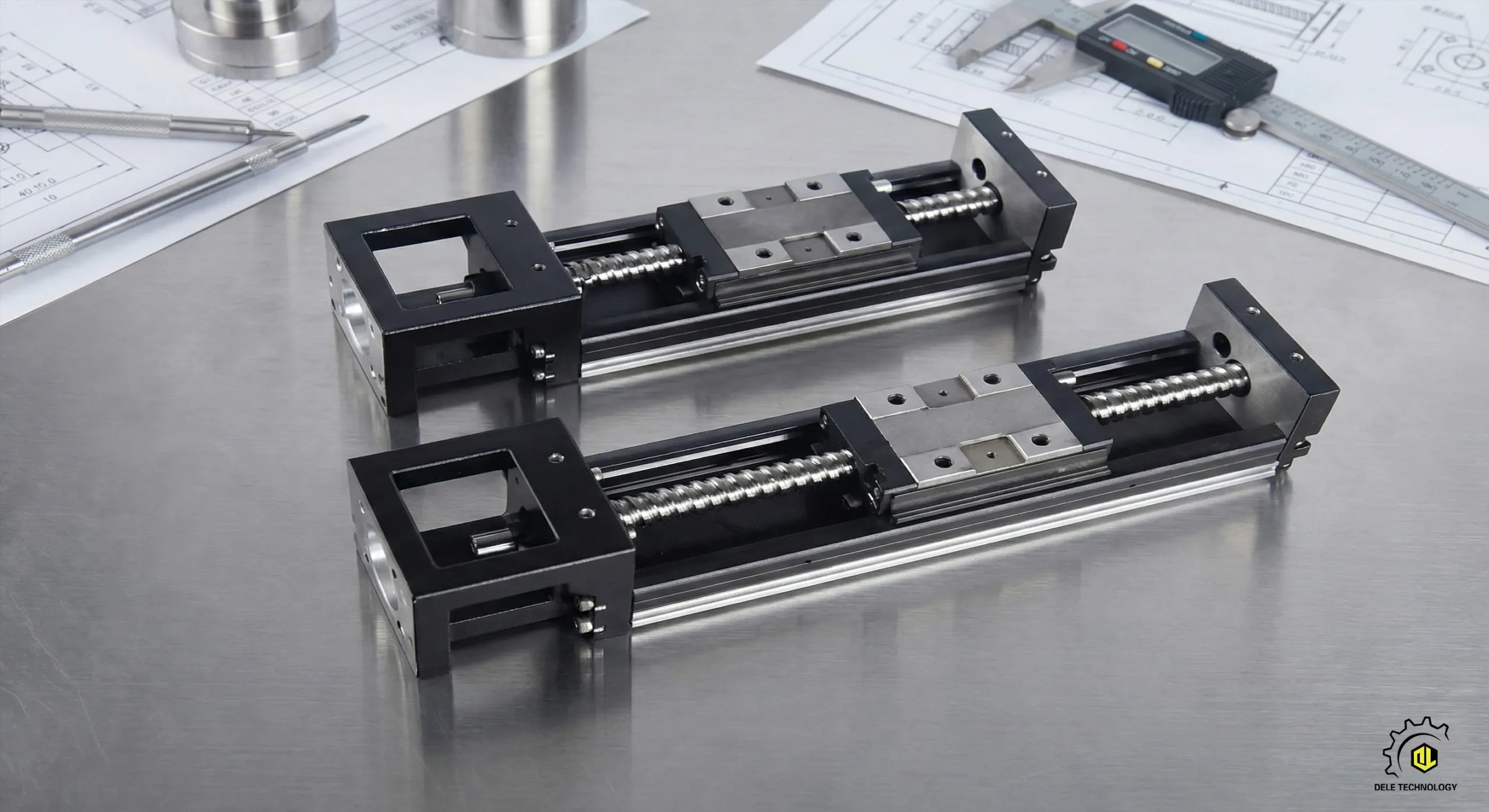
To understand the KK module, one must first understand the fundamental difference between “assembled” linearity and “integrated” linearity.
Standard linear actuators typically consist of an aluminum base extrusion with a separate stainless steel guide rail bolted onto it. The KK series defies this by utilizing a U-shaped ferritic steel track that serves a dual purpose: it is both the structural chassis and the raceway for the recirculating balls.
The Stiffness Advantage
From a mechanics of materials standpoint, the U-shape is ingenious. By integrating the raceway directly into the chassis, we eliminate the “bi-material effect” often seen in aluminum actuators where thermal expansion mismatch causes bowing.
More importantly, the U-shape maximizes the Area Moment of Inertia (I) relative to its cross-sectional area. When we analyze the deflection (δ) under a cantilever load, we rely on the standard beam equation:
$$ \delta = \frac{F \cdot L^3}{3 \cdot E \cdot I} $$
Where:
- F is the force.
- L is the length.
- E is Young’s Modulus (Steel is ≈200 GPa vs. Aluminum’s ≈70 GPa).
Because the KK module is steel throughout, its resistance to bending (E⋅IE⋅I) is significantly higher than an aluminum module of comparable volume. This makes the KK series the only viable option for high-precision applications where space is constrained, yet high rigidity is non-negotiable.
The “Hidden” Geometric Errors: Pitch, Yaw, and Roll

Catalog data provides a static “Basic Dynamic Load Rating” (CC). However, in 90% of KK module failures I have investigated, the failure was not due to axial fatigue, but due to unaccounted moment loads.
Because the KK module uses a Gothic Arch groove design (4-point contact), it can handle loads in all directions. However, the distance between the load application point and the geometric center of the slider (the moment arm) creates torque.
The Stiffness-Accuracy Trade-off
The compactness of the KK block means the spacing between the recirculating ball circuits is small. This results in a lower moment stiffness compared to a wide-body dual-guide system.
- Pitching (My): When the payload is cantilevered forward, the block tends to tilt. In high-speed scanning applications, this manifests not as a jam, but as Abbe Error. A mere 10 arc-seconds of pitch deviation can result in microns of error at the tool tip, depending on the height of the payload.
- Yawing (Mz): Often caused by side-mounted loads. This significantly increases friction and wear on the ball screw nut, leading to premature backlash development.
Thermal Dynamics and The “Pre-Tension” Myth
Engineer’s Insight: If your application requires high moment capacity, do not simply oversize the KK module. Instead, consider a dual-block configuration. A second block on the same rail effectively squares the moment capacity, transforming a moment load into a pure radial load distributed between the two blocks.
Thermal Dynamics and The “Pre-Tension” Myth
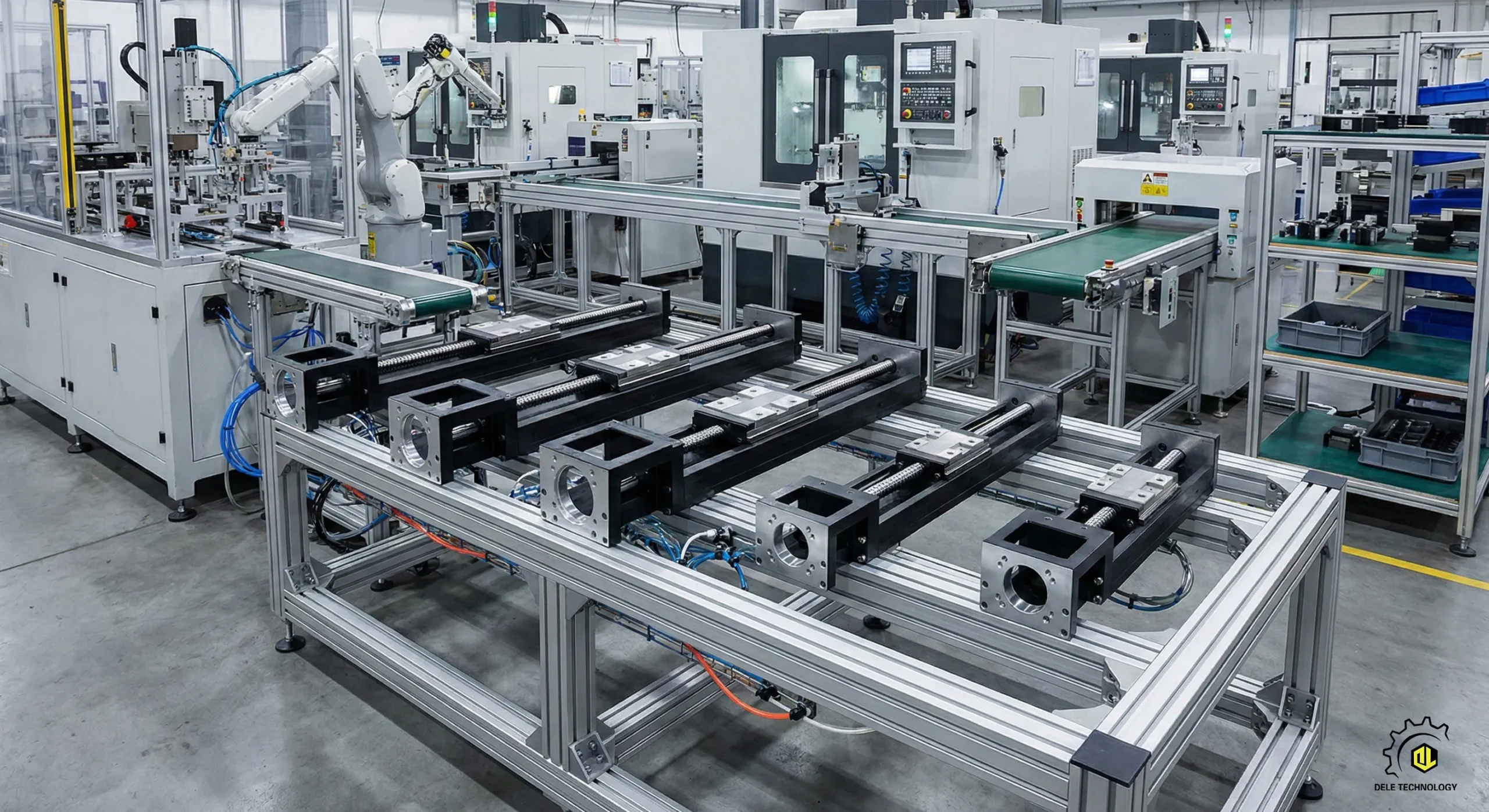
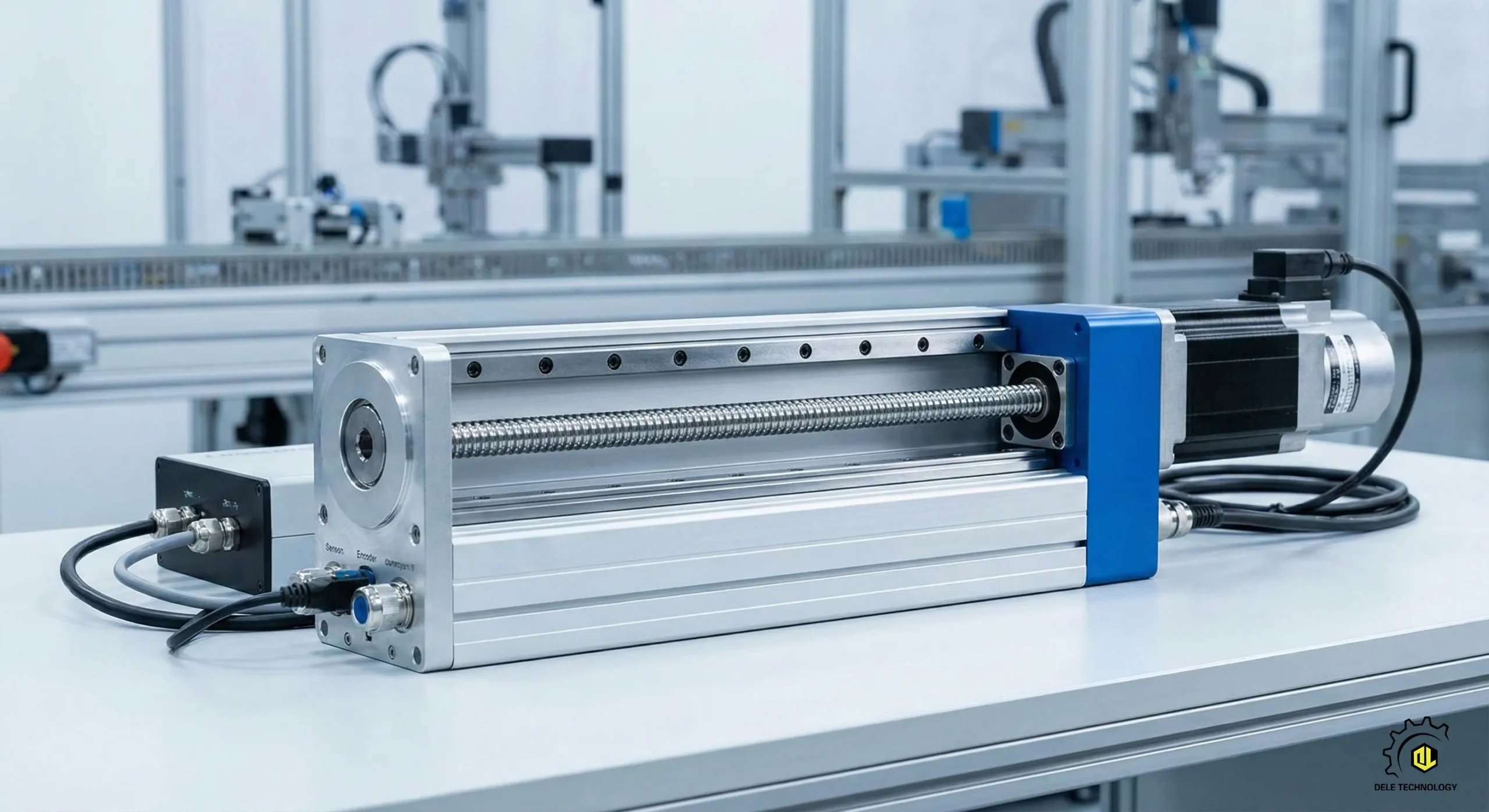
One of the most esoteric yet critical topics in linear modules is thermal displacement. In a KK module, the ball screw is enclosed within the U-channel. This creates a “heat tunnel” effect.
The Heat Dissipation Challenge
Unlike open systems where air circulates freely, the friction from the ball screw and the guide blocks generates heat that is trapped within the steel U-channel. Steel has a lower thermal conductivity than aluminum, meaning the heat stays localized.
As the temperature rises, the ball screw shaft expands. The formula for thermal expansion is:
ΔL=α⋅L⋅ΔT
For a 500mm steel screw, a 10℃ rise results in approximately 60μm of elongation. In precision bonding or lithography, 60μm is catastrophic.
The Pre-Tension Limitation
In larger, discrete ball screw assemblies, we mitigate this by “pre-tensioning” the screw (stretching it between bearings). However, most standard KK modules do not allow for significant pre-tensioning due to their compact bearing housing design. The fixed-supported bearing configuration usually allows the screw to expand towards the supported end.
Recommendation: For continuous duty cycles (100% duty) where heat generation is constant, you must account for this drift in your control loop, or opt for a module with a hollow shaft for cooling (rare in KK sizes) or simply use linear scales for full closed-loop feedback.
Lubrication: The Silent Killer in Short-Stroke Applications
This is a topic rarely discussed in catalogs but is well-known in the semiconductor industry. KK modules are often used for “dithering” or very short stroke movements (e.g., wire bonding, < 5mm strokes).
The Mechanics of Starvation
Grease relies on the movement of the rolling elements to circulate and form an elastohydrodynamic film. In short strokes, the balls do not rotate enough to carry fresh grease into the load zone. This leads to fretting corrosion—a wear mode where the contact surfaces weld and tear at a microscopic level due to lack of oil film.
The Solution: If your application involves short strokes, standard lithium soap grease is insufficient. You must:
- Program a “maintenance cycle” where the module performs a full stroke every few thousand cycles to redistribute lubricant.
- Specify high-performance urea-based greases or specialized AF (Anti-Fretting) lubricants during the ordering process.
Comparative Analysis: KK Steel vs. Aluminum Modules
To help you make the final decision, here is a structured comparison based on field characteristics rather than just price.
| Feature | KK Series (Steel U-Channel) | Standard Aluminum Module | Engineer’s Verdict |
| Material Stiffness | High (Steel Chassis) | Moderate (Aluminum Extrusion) | KK wins for cantilevered loads and precision. |
| Thermal Stability | Lower (Heat trap) | Higher (Aluminum dissipates heat) | Aluminum is better for high-speed, continuous motion without scales. |
| Geometric Accuracy | High (Integrated grinding) | Variable (Assembly tolerance) | KK offers superior straightness per meter. |
| Mounting Flatness | Critical (Rigid body) | Forgiving (Flexible body) | KK requires a precision-machined mounting surface; otherwise, the rail will twist. |
| Customizability | Low (Standard molds) | High (T-slots everywhere) | Use Aluminum if you need to mount sensors/cameras arbitrarily. |
Engineer’s Insight: If your application requires high moment capacity, do not simply oversize the KK module. Instead, consider a dual-block configuration. A second block on the same rail effectively squares the moment capacity, transforming a moment load into a pure radial load distributed between the two blocks.
Conclusion
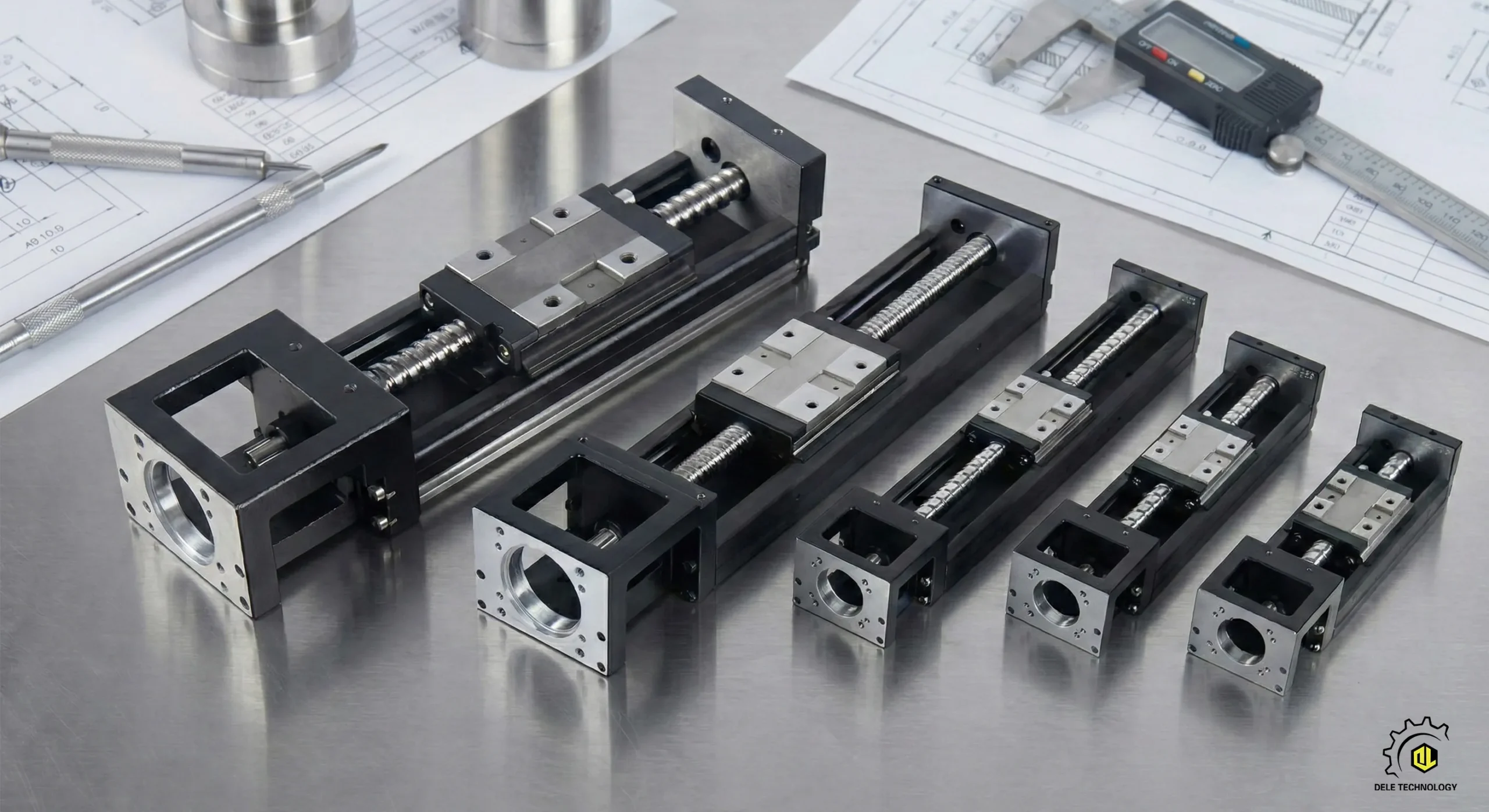
The KK module series represents a triumph of integrated engineering—packing the rigidity of a steel table into the footprint of a linear actuator. However, its high stiffness and precision come with the responsibility of correct application.
In addition, our DLEL company is a professional manufacturer of precision transmission units. If you have any manufacturing and purchasing needs for the KK series module, you can contact us. We believe that we can bring you excellent service experience and product quality!
FAQ
Q1: Can I mount the KK module vertically (Z-axis) without safety risks?
A: Deploying a KK module vertically is standard practice, but because the high transmission efficiency (>90%) of the ball screw makes it inherently back-drivable, a motor with an integrated electromagnetic brake is mandatory to prevent the payload from crashing during power loss. Furthermore, engineers must not rely on the horizontal load rating; always reference the specific “vertical rated load” in the datasheet, which is typically derated to 1/3 or 1/5 of the horizontal capacity due to the lack of mechanical advantage against gravity.
Q2: Do I really need the expensive “Precision” (P) grade, or is “Normal” (C) grade sufficient?
A: Many engineers over-specify “Precision” (P) grade modules without realizing that unless the machine operates in a strictly temperature-controlled environment (±1°C), the thermal expansion of the steel body will physically swamp the micron-level manufacturing advantage of the P grade. For 95% of automation tasks, the standard “Normal” (C) grade offers sufficient repeatability (±0.01mm), and the budget is better spent on a flatter, more rigid mounting surface rather than chasing theoretical accuracy that vanishes with a 5°C temperature swing.
Q3: My module is making noise after six months—are the ball bearings shattered?
A: If a module develops noise after months of operation, it is rarely due to shattered ball bearings but rather “lubrication starvation” caused by short-stroke dithering, where the balls fail to rotate fully and carry grease into the load zone. Before replacing the unit, perform a maintenance cycle by running the slider across the full stroke to redistribute the lubricant; if the noise persists as a specific frequency hum, investigate the servo gain settings for resonance rather than mechanical failure.
Q4: Why is the KK series significantly more expensive than aluminum profile actuators?
A: The price premium of a steel KK module over a standard aluminum extrusion actuator is justified by its “stiffness-to-volume” ratio; the integrated U-shaped steel chassis provides 3-5 times the moment rigidity of an aluminum assembly. For optical inspection or high-speed pick-and-place, this rigidity translates directly into reduced “settling time” (stopping vibration instantly), meaning you are not just paying for a component, but for the faster cycle times and lower Abbe errors that aluminum simply cannot physically support.
Q5: Can I remove the slider block from the rail for maintenance?
Engineer’s Insight: Removing the slider block from the rail without a plastic dummy shaft is a catastrophic error that will cause the non-retained ball bearings to scatter immediately. Because these balls are micron-matched to establish the specific preload class, attempting to reassemble them by hand is futile and will result in a jammed or loose block; in such events, it is almost always more cost-effective to replace the entire module than to attempt a factory-level rebuild in the field.